
COVID-19 UPDATES
Important IKORCC COVID-19 Updates
April 13, 2020
Annuity Update: Coronavirus Aid, Relief and Economic Security (CARES) Act Distributions
April 3, 2020
UBC Offers ICRA & COVID-19 Training Online
April 1, 2020
Your Rights During COVID-19 Pandemic
March 30, 2020
Health & Welfare Updates for COVID-19 Pandemic
March 27, 2020
Families First Coronavirus Response Act: Member Guidance
March 25, 2020
IN, KY, OH Governors Exempt Construction From Stay-at-Home Orders
March 18, 2020
Training Centers Closed Due to COVID-19
March 14, 2020


FREQUENTLY ASKED QUESTIONS
What should I do if I get laid off?
If you are laid off immediately contact your business representative & get on the out-of-work list.
Call 888-875-9819 to get on the out-of-work-list.
If you are unable to work during this time due to illness concerns or a lack of work due to COVID-19, you may qualify for unemployment under state orders.
Click your state below for more information on unemployment:
How can I stay safe on the job site?
You can stay safe by washing your hands frequently or using hand sanitizer. Try your best to maintain a safe distance from other people. Take your temperature before going to work and stay home if you feel sick. If you have any concerns about your particular job site, please contact your business representative.
Here are some more recommendations from the Centers for Disease Control on staying safe:
Are council offices still open?
Council and local offices remain open to service members and man jobs, however, we encourage members not to visit in person. Instead, contact the locals and council via phone, email, website or on our social media channels.
Are training centers open?
In an effort to minimize the spread of the Coronavirus (COVID-19), all training centers in Indiana, Kentucky, and Ohio will be closed until May 4th, 2020. Training instructors & admins will reach out to apprentices directly to reschedule classes.
Will any training be offered online?
Yes. Currently, the United Brotherhood of Carpenters and the Carpenters International Training Fund are offering eligible members the opportunity to take Infection Control Risk Assessment (ICRA) and COVID-19 classes online. Read more here: UBC Offers Online Courses
How do I register for ICRA & COVID-19 training online?
- Go to https://www.carpenters.org/
- In the upper right corner, hover over “resource hub”. There will be a dropdown.
- Click on “For Our Members”.
- Scroll down to the brown section and click on “Access to the CITF Online Learning Center” to expand the box.
- Click on “Click Here” to register for classes online.
- That should take you to a login page. Create an account if you don’t already have one.
- Sign in with your email in lowercase.
- Go to “dashboard” and click on the class that you would like to take. Complete the modules and answer the questions.
Additional Tips:
- If you are struggling with the UBC’s sign-in process, contact us at website@ikorcc.com or call your local’s admin.
- After you have your email address straightened out, if you get stuck in a sign-in loop, close your internet browser. Reopen the browser and try to sign-in again.
- If you still have trouble, contact a business agent or your local hub.
What is the Families First Coronavirus Response Act?
On March 18, 2020, the Families First Coronavirus Response Act was signed into law in the United States, and it gives new benefits to many workers whose families have been affected by the COVID-19 crisis. You can read more about what this means for UBC members here: Families First Coronavirus Response Act Summary
What is the CARES Act & how does it help me?
This law will spend $2 trillion from the federal treasury to help Americans get through the current crisis. Here are some details about several of the provisions that may be of interest to UBC members.
- Direct payments to American workers — U.S. residents whose adjusted gross income is less than $75,000 or married couples making less than $150,000 will receive $1,200 per adult and $500 per child. Income limits change with number of children, and the amount decreases if you exceed the income limit. The IRS is saying that most people will receive these payments automatically, beginning in the next three weeks. For more information, check here: https://www.irs.gov/newsroom/economic-impact-payments-what-you-need-to-know
- Unemployment Insurance enhancements — Laid-off workers will receive an increase of $600 per week in their benefits. This could last for up to four months, but not past July 31, 2020. Through 2020, members will be eligible to receive unemployment for an additional 13 weeks before it is exhausted. Many states have waived the waiting week, and are making other changes that could be helpful. Unemployment Insurance is run by each state, so your situation will depend on where you live. Check here for more information or to look up your state’s page: https://www.careeronestop.org/LocalHelp/UnemploymentBenefits/find-unemployment-benefits.aspx
- Mortgage Relief — Borrowers with federally-backed mortgages (FHA, VA) or mortgages purchased by Fannie Mae or Freddie Mac would suspend mortgage payments for an initial 180 days (and possibly get a subsequent 180 day extension) without accruing additional fees or interest by attesting they are having financial hardship due to the coronavirus.
- Penalty waived for access to retirement plans — This new law temporarily waives the 10% IRS penalty for accessing some retirement plans, including 401Ks and annuity plans. Coronavirus impacted individuals with retirement plan loans due by December 31, 2020 would have an extra year to repay them.
- REAL ID extension — The implementation of REAL ID has been pushed back for a full year and will now take effect on October 1, 2021.
Have there been any health & welfare changes?
Yes. In response to the COVID-19 pandemic, several changes have been made to health & welfare plans in Indiana, Kentucky and Ohio to help members during this time. Read the full changes here: Health & Welfare Updates
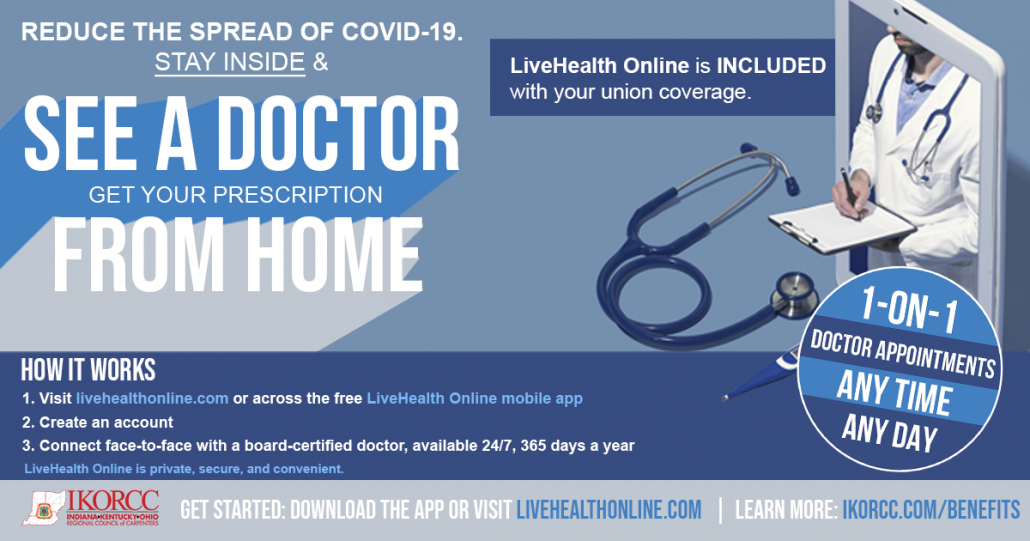
Can I see a doctor from home?
Yes! You can still utilize the livehealthonline.com service from home during this time. Available 24/7, 365 days a year. LiveHealth Online is included with your union health coverage. LiveHealth Online uses two-way video to connect you with U.S.-based board-certified doctors. And since it’s an online experience, it’s quick, easy and always on your terms. And convenience also comes with excellent service. Doctors using LiveHealth Online can answer your questions, assess your condition and even provide prescriptions* if needed.
Use LiveHealth Online if you are experiencing any of the following:
• Cold and flu symptoms such as a cough, fever or headache.
• Allergies • Sinus Infections
• Headache/Migraine
• Nausea/Vomiting
• Rashes/Skin disturbances
• Sore throat/pharyngitis
• And much more!
Important Phone Numbers
Out-of-Work List
888-875-9819
Indiana
Council Offices
Greenwood: 317.807.5722
Evansville: 812.490.0500
Northwest: 219.942.0518
Warsaw: 574.269.4220
Training Centers
Newburgh: 812.853.9312
Merrillville: 219.947.3348
Lafayette: 765.447.5959
Muncie: 765.288.9015
Indianapolis: 317.807.1116
Warsaw: 574.267.5264
Terre Haute: 812.466.7899
Kentucky
Council Offices
Ashland: 606.420.4072
Louisville: 502.375.8667
Paducah: 270.442.1148
Training Centers
Ashland: 606.929.1362
Louisville: 502.366.8668
Paducah: 812.853.9312
Ohio
Council Offices
Akron/Canton: 330.773.9977
Cleveland: 216.391.2828
Columbus: 614.236.2440
Monroe: 513.539.2759
Rossford: 419.893.2317
Youngstown: 330.746.0551
Training Centers
Columbus: 614.236.4205
Monroe: 513.539.7849
Richfield: 330.659.9495
Rossford: 419.872.4651
Benefits
Indiana & Kentucky:
800.700.6756
Ohio:
855.837.3528
IMPORTANT LINKS
Important Links
Centers for Disease Control: COVID-19
How to Cope with Anxiety About Coronavirus
Indiana:
Information from the Indiana State Government
Governor Holcomb’s News Releases
Kentucky:
Information from the Kentucky State Government
Governor Beshear’s Press Releases & Executive Action
Ohio:
CDC Recommendations