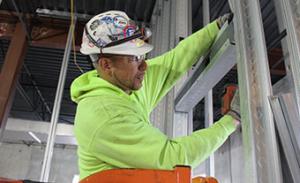
Jerome Stanford completed the apprenticeship program with hundreds of others from Indiana and Kentucky and were honored with a completion ceremony in December 2015. As the selected speaker to represent the graudation class, Jerome addressed the members and guests that night.
American workers have felt a slow decline in their wages since the early 1980s, meaning wage increases have been slightly lower than the cost of living increase. This means less money for groceries, clothing, your children and the everyday essential you may need for raising a family or saving for retirement.
Union wages for the construction industry are no different, except unions have contracts that include wage increase, healthcare and retirement plans. With ongoing training programs for apprentices and journeymen this allows the workers to be more skilled than the nonunion workers. Productivity levels are higher, accidents are lower, and attitudes on job sites are more positive than ever before because of the investments in training by the members and their union. These union contracts are agreements between Labor and Contractors. The more highly skilled workers usually result in better wages, better working conditions and better benefits for their family.
On the other hand, payroll fraud is spreading rampant through the construction industry. This is where unscrupulous nonunion contractors choose to hire hourly workers and pay them cash or as independent contractors (1099s) by not withholding the employee’s state or federal tax deductions, FICA withholdings and Medicare deductions, leaving this responsibility on the workers to pay.
/wp-content/uploads/2024/02/CMWCarpenterslogoFIN.png00IKORCC/wp-content/uploads/2024/02/CMWCarpenterslogoFIN.pngIKORCC2016-01-05 00:00:002019-06-23 04:36:55Why should politics matter to you?
LOUISVILLE, Ky. – Gaining access to an affordable education and a hands-on, in-the-field apprenticeship have been made possible through the Indiana/Kentucky/Ohio Regional Council of Carpenters (IKORCC) Training Center in Louisville.
Out of the approximate 35,000 IKORCC members throughout the three-state span, 5,000 millwrights, carpenters and floor coverers live and work in Kentucky, and the Louisville Training Center is home to nearly 500 apprentices working in the field.
The 100,000 square foot training center – recently visited by elected Kentucky representatives and senators on a tour that was led by instructor Hope Harp – offers a four-year apprenticeship program where students spend a minimal amount of time in the classroom – they are required to attend week-long classes four times per year – and a bulk of their time being trained and mentored by experienced journeypersons on job sites. While on the job, students are compensated for their work.
Out-of-pocket expenses for the students are also kept to a minimum, averaging about $100 annually for text books.
Apprentices in carpentry, millwright work and floor covering who complete the four-year program graduate with an associate’s degree in Applied Science from Ivy Tech State College, an education valued around $17,000, and hit the ground running with a career as a journeyman.
Graduates can further their education by pursuing a bachelor’s degree through an established educational facility with an apprenticeship program. Other graduates have obtained high-level and advanced manufacturing positions at Fortune 500 companies, including Ford and GE.
“Apprentices are the future of our industry, and it’s so important they have access to the right resources and education,” commented Richard Fouts, Senior Manager of the IKORCC. “The Louisville Training Center apprenticeship program is a one-of-a-kind program that offers students an invaluable experience that couldn’t be taught in the classroom. We’re starting to notice a deficit in the workforce due to older generation retiring or leaving, and projects that used to take 12 weeks are taking 20 weeks to complete. That’s why it’s so important to educate the younger generation and provide them with the tools necessary to succeed.”
Individuals seeking to become an apprentice through the Louisville Training Center program are required to have a high school diploma or GED and must pass a written exam distributed by the Kentucky Community and Technical College System (KCTCS) and interview at the training facility. For direct access into the program, veterans can go through the Helmets to Hardhats program. The Training Center also recruits through various minority organizations, including the Bridges to Opportunities Workforce Training Program, the Youthbuild Louisville Program, Job Corps and SkillsUSA Kentucky.
The training center also offers continuing education for current IKORCC members seeking to improve skills and abilities.
For more information, please contact the IKORCC Louisville Campus, 1245 Durrett Lane, 502.375.8667, email info@ikorcc.com or visit www.IKORCC.com.
https://www.cmwcarpenters.com/wp-content/uploads/2019/06/13-1_0.jpg126500IKORCC/wp-content/uploads/2024/02/CMWCarpenterslogoFIN.pngIKORCC2015-09-17 00:00:002019-06-22 23:20:34Carpenter’s Union Training Facility Offers Hands-On Apprenticeship Program
Construction workers in Kentucky contribute $20 million to state and local taxes. This allows policy makers to balance budgets and fund infrastructure and public safety without raising taxes on everyone else.
However, workers NOT paid prevailing wage are eligible for up to $8,000 in public assistance, which costs taxpayers for additional reliance on cash assistance, food stamps and unpaid visits to the emergency room. Taxpayers don’t save without prevailing wage, they SUBSIDIZE low-wage jobs.
Prevailing wage is the wage paid to skilled construction workers on publicly funded projects estimated to cost more than $250,000. The wages are set by Kentucky’s Labor Cabinet based on what construction workers in the area make on private sector projects. This forces big government to abide by local private sector economies.
[i] Kentucky’s Prevailing Wage Law, an Economic Impact Analysis, Peter Philips, Ph.D., 2014. [ii] Economic Policy Brief, Working Partnerships USA, 2011.
Every dollar spent on a prevailing wage project generates $1.50 in economic activity – that’s money spent at local businesses such as restaurants, shops and grocery stores – spurring additional job creation that keeps local businesses and economies strong.
In fact, the economic activity generated by prevailing wage projects supports 2,643 non-construction jobs in Kentucky!
Prevailing wage is the wage paid to skilled construction workers on publicly funded projects estimated to cost more than $250,000. The wages are set by Kentucky’s Labor Cabinet based on what construction workers in the area make on private sector projects. This forces big government to abide by local private sector economies.
/wp-content/uploads/2024/02/CMWCarpenterslogoFIN.png00IKORCC/wp-content/uploads/2024/02/CMWCarpenterslogoFIN.pngIKORCC2014-12-03 00:00:002019-06-21 06:53:20Prevailing Wage Drives Kentucky’s Economic Development